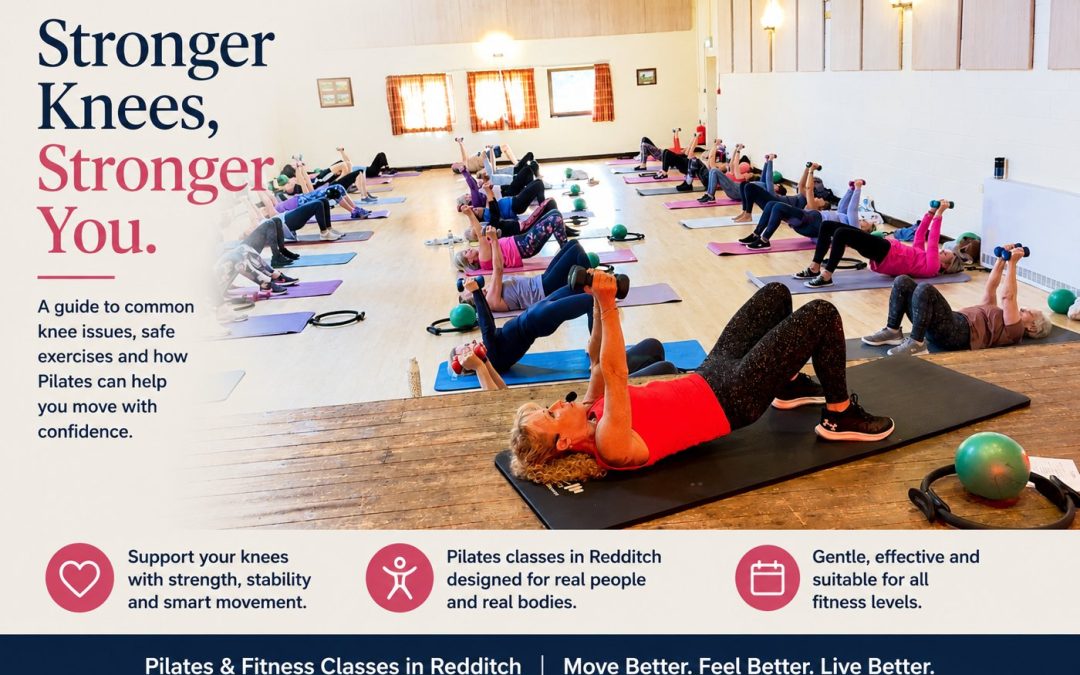
A Guide to Stronger, Healthier Knees for Exercise Classes in Redditch
Knee pain is one of the most common reasons people stop exercising — but in many cases, the right type of movement can actually help improve knee strength, stability, and confidence.
At my fitness and Pilates classes in Redditch, I often work with people experiencing stiff, aching, or uncomfortable knees. Whether it’s caused by arthritis, previous injuries, muscle weakness, or everyday wear and tear, understanding what’s happening in the body can help you move more safely and comfortably.
The good news? Most knee problems are not simply “knee problems.” They are often linked to hip strength, core stability, posture, balance, and movement patterns throughout the body.
In this guide, we’ll look at some of the most common knee conditions, exercises that may help, movements to be cautious with, and simple ways to support long-term knee health through exercise.
Osteoarthritis (OA)
What Is Knee Osteoarthritis?
Osteoarthritis is a gradual wearing down of cartilage within the knee joint. This can lead to stiffness, discomfort, swelling, and reduced movement.
It’s especially common in adults over 50, but regular gentle exercise can often help improve mobility and reduce pain.
Common Symptoms
- Knee stiffness, especially in the morning
- Pain during or after activity
- Reduced flexibility
- Swelling around the joint
Helpful Exercise Focus
- Improving hip, knee, and ankle alignment
- Strengthening glutes and quadriceps
- Controlled low-impact movement
- Working within a comfortable range
Exercises to Be Careful With
- Deep loaded squats if painful
- High-impact jumping
- Fast uncontrolled movements
Patellofemoral Pain Syndrome (“Runner’s Knee”)
What Is It?
This condition causes pain around or behind the kneecap and is often linked to poor knee tracking, muscle imbalance, or overload.
It’s very common in active adults and people returning to exercise after time away.
Common Symptoms
- Pain walking downstairs
- Aching after sitting for long periods
- Clicking or discomfort around the kneecap
Helpful Exercise Focus
- Strengthening the quadriceps and glutes
- Improving hip stability
- Teaching proper knee alignment
Avoid
- Deep knee bending early on
- Poorly aligned lunges
- Letting knees collapse inward
Meniscus Injuries
What Is the Meniscus?
The meniscus is cartilage that cushions the knee joint. Injury can occur through twisting, sudden movement, or degeneration over time.
Common Symptoms
- Locking or catching sensations
- Swelling
- Pain during twisting movements
Helpful Exercise Focus
- Controlled strengthening
- Stability and balance work
- Straight-line movement patterns
Avoid
- Twisting under load
- Deep squats if painful
- Sudden directional changes
Ligament Injuries (ACL, MCL and Others)
What Are Ligament Injuries?
Ligaments stabilise the knee joint. Sprains or tears can affect balance, control, and confidence in movement.
Common Symptoms
- Instability or “giving way”
- Swelling
- Pain when weight-bearing
Helpful Exercise Focus
- Stability training
- Gradual strengthening of glutes, quads, and hamstrings
- Controlled movement patterns
Avoid
- Jumping or pivoting too soon
- Heavy loading early in recovery
- Unstable exercises before strength improves
Tendinopathy Around the Knee
What Is Tendinopathy?
This is an overuse condition affecting the tendons above or below the kneecap.
Common Symptoms
- Pain around the kneecap
- Increased pain with repeated activity
- Tenderness after exercise
Helpful Exercise Focus
- Gradual strengthening
- Controlled loading
- Managing exercise volume carefully
Avoid
- Sudden increases in intensity
- Excessive jumping or explosive work
- Ignoring ongoing pain
IT Band Syndrome
What Is IT Band Syndrome?
The IT band runs along the outside of the thigh and can become tight or irritated, affecting knee movement and alignment.
Common Symptoms
- Pain on the outside of the knee
- Tightness through the outer thigh
Helpful Exercise Focus
- Glute strengthening
- Hip stability work
- Mobility exercises
Avoid
- Overloading without improving hip strength
- Ignoring alignment during exercise
Key Principles for Healthy Knees During Exercise
Whether you attend Pilates, mobility sessions, strength classes, or beginner fitness classes in Redditch, these principles are incredibly important:
Prioritise:
- Good posture and alignment
- Hip and core stability
- Slow, controlled movement
- Quality over quantity
- Consistency over intensity
For many people, especially over 40s and 50s, gentle and consistent movement works far better than high-impact exercise.
Best Exercises for Knee Strength and Stability
The most effective knee-friendly exercises usually focus on:
- Stronger glutes and quadriceps
- Better hip and ankle mobility
- Controlled stability work
1. Sit-to-Stand (Chair Squats)
One of the best exercises for everyday strength and independence.
Benefits
- Strengthens thighs and glutes
- Improves balance and confidence
- Helps with everyday movement patterns
2. Glute Bridges
Weak glutes often place extra stress on the knees.
Benefits
- Supports knee alignment
- Improves hip stability
- Reduces pressure on the front of the knee
3. Step-Ups
Excellent for improving stair strength and knee control.
Benefits
- Functional lower-body strength
- Balance and coordination
- Controlled knee stability
4. Heel Raises
Strong calves help support healthy walking mechanics and ankle stability.
Benefits
- Improves walking efficiency
- Reduces stress through the knees
- Supports balance
5. Clamshells
Fantastic for strengthening hip stabilisers.
Benefits
- Improves knee tracking
- Strengthens glute medius
- Helpful if knees roll inward
6. Terminal Knee Extensions
A gentle but effective exercise for quad activation.
Benefits
- Strengthens the VMO and quadriceps
- Helps support aching knees
- Low-impact strengthening option
7. Gentle Mobility Work
Stiff hips and ankles often contribute to knee pain.
Helpful mobility exercises:
- Calf stretches
- Hip flexor stretches
- Hamstring mobility
- Ankle circles
- Gentle knee bends
Smooth, pain-free movement is always the goal.
A Simple Knee-Friendly Routine
Try this routine 3–4 times per week:
- Sit-to-Stand — 10 reps
- Glute Bridges — 12 reps
- Heel Raises — 15 reps
- Clamshells — 10 each side
- Step-Ups — 8 each side
- Gentle calf stretch
This takes around 10 minutes and can make a big difference when done consistently.
Exercises to Be Careful With
If your knees are irritated, take extra care with:
- Deep squats
- Poorly aligned lunges
- Twisting movements
- Fast transitions
- High-impact exercise
Remember:
- Mild muscle effort is normal
- Sharp joint pain is not
- Slow control beats speed every time
The Big Takeaway
Most knee discomfort is influenced by much more than the knee itself.
Improving hip strength, core control, posture, balance, and movement quality can dramatically improve knee function and confidence with exercise.
If you’re looking for supportive, low-impact fitness or Pilates classes in Redditch that focus on strength, mobility, posture, and joint-friendly movement, feel free to get in touch and find a class that suits your needs.
Why Pilates Is Excellent for Knee Health
Pilates can be one of the safest and most effective forms of exercise for people managing knee pain, stiffness, weakness, or recovering from injury.
Unlike high-impact workouts that can place excessive stress on the joints, Pilates focuses on controlled movement, alignment, stability, and strength — all of which are incredibly important for healthy knees.
At my Pilates classes in Redditch, we focus on improving the strength and control of the muscles that support the knees, including the glutes, core, hips, hamstrings, and quadriceps. Many people are surprised to discover that improving hip stability and posture can significantly reduce pressure through the knees.
Benefits of Pilates for Knee Health
Pilates can help:
- Improve joint stability
- Strengthen supporting muscles without heavy impact
- Improve posture and movement patterns
- Increase flexibility and mobility
- Support balance and coordination
- Reduce stiffness and improve confidence in movement
Because Pilates exercises are low-impact and easily adaptable, they can be suitable for many people with:
- Osteoarthritis
- Knee stiffness
- Previous knee injuries
- Weakness after inactivity
- Balance or mobility concerns
- General aches and pains associated with ageing
Many clients attending my beginner-friendly Pilates and fitness classes in Redditch are looking for a gentler, more supportive approach to exercise that still helps them build strength, improve mobility, and stay active long term.
Pilates Focuses on the Whole Body — Not Just the Knee
One of the biggest benefits of Pilates is that it looks at how the entire body moves together.
Rather than simply “exercising the knee,” Pilates helps improve:
- Core strength
- Hip stability
- Balance
- Alignment
- Breathing and body awareness
- Functional movement patterns
This whole-body approach is often why people notice improvements not only in their knees, but also in their posture, back comfort, walking, balance, and overall confidence with movement.
Looking for Pilates Classes in Redditch?
If you’re searching for supportive, low-impact Pilates classes in Redditch that focus on strength, mobility, posture, and joint-friendly exercise, Pilates could be a fantastic option. https://keepfitwithmichelle.co.uk/classes/pilates/
Classes can help you:
- Build strength safely
- Improve flexibility and stability
- Move with more confidence
- Support long-term joint health
- Stay active without excessive impact on the knees
Whether you’re new to exercise, returning after injury, or simply looking for a more joint-friendly way to stay fit, Pilates can be an excellent addition to your routine.
Info: www.keepfitwithmichelle.co.uk
Book Here: https://gymcatch.com/app/provider/1872
